
Vision
Sustainability Healing
How to live Sustainability?
Sustainability is not a modern invention; its roots reach far back into history. As early as ancient times, Greek philosophers were already reflecting on humanity’s relationship with nature and the responsibility people carry toward the world around them. Later, during the Enlightenment, thinkers again began to question how humans should live within the limits of the natural world. Throughout history, the idea of sustainability has repeatedly emerged in times of crisis. When societies face environmental, social, or economic challenges, these moments often spark a shift in awareness—a deeper realization of the value and fragility of our planet and the need to protect it.
In many ways, Indigenous cultures represent a powerful symbol of lived sustainability. For countless generations, Indigenous communities have lived in close harmony with their environment, using natural resources with care and respect. Their way of life shows that sustainability can be practiced intuitively—long before the concept itself was ever named. For them, living sustainably was not a theory or a political goal, but a natural and deeply rooted part of everyday life.
The term “sustainability” itself originally comes from forestry. It was shaped in the early 18th century by the German forester Hans Carl von Carlowitz. Faced with severe wood shortages, he proposed a simple yet profound principle: only as many trees should be cut down as can grow back naturally. In this way, the forest—and the system with all its essential characteristics—could be preserved over the long term. This idea laid the foundation for what we today understand as sustainability: using resources in a way that ensures that natural systems remain healthy and capable of supporting life for generations to come.
There are many different ways to live sustainability, but at its heart it always begins with awareness and responsibility. I see myself as one of the “children of sustainability,” guided by the principle of glocality—the idea that global and local perspectives must be connected. Real change starts locally, in the places where we live and act every day, while at the same time remaining aware of the larger global relationships and consequences of our actions. What happens in one small place on Earth is always part of a much bigger system.
As a free acting social scientist i feel a deep responsibility to actively seek out places of sustainability around the world, to learn from them, to listen, and to engage in meaningful dialogue. These encounters create opportunities for exchange—across cultures, disciplines, and generations. The knowledge and experiences gathered in these global contexts can then be brought back into local communities, where they can inspire practical action and new ways of thinking.
Sustainability, in this sense, becomes a living process of interdisciplinary knowledge exchange. It is about sharing values, lifestyles, and solutions that help us navigate the challenges of our time—especially in an age often described as one of ecological crisis or even ecocide. Creating spaces for conversation is essential: dialogue circles where people can reflect together, learn from each other, and search for meaningful responses to the crises we face.
A particularly important part of this work is the accompaniment and empowerment of children growing up in uncertain times. They are the generation that will inherit the consequences of today’s decisions. Supporting them means giving them space to ask questions, to express their fears and hopes, and to develop their own visions for the future. In doing so, the principle of intergenerational justice becomes central: the responsibility to ensure that the needs of future generations are respected and protected.
Places of sustainability therefore become more than just physical locations. They are living laboratories where people come together to imagine and practice new, sustainable ways of living—ways that respect the Earth, strengthen communities, and open pathways toward a more just and resilient future.
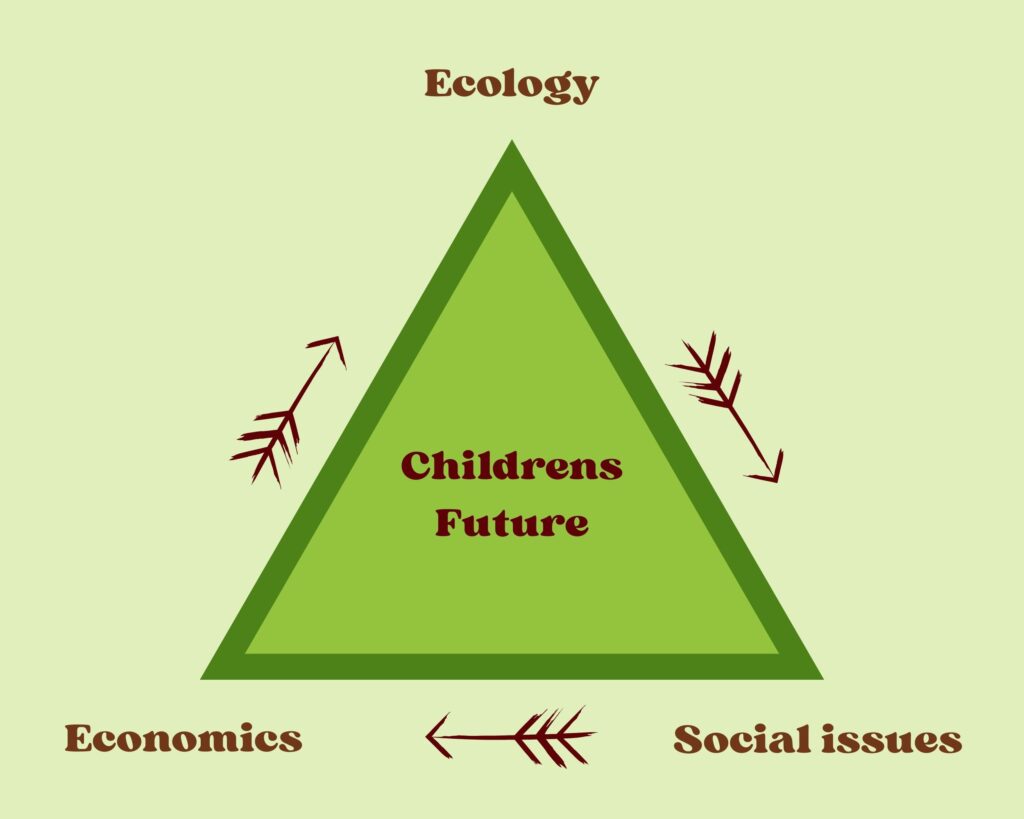
Sustainability triangle
Based on the Sustainability triangle of Pufé 2014
Free educational Processes
Free and guided educational processes take place in spaces dedicated to sustainability. In these environments, children observe the interconnections between economic, ecological, and social processes. Through this holistic perspective, they develop a deeper understanding of sustainable lifestyles that can adapt to changing contemporary conditions. The overall aim is not only to foster an internalized sense of responsibility, but also to enable active and concrete participation in local community life.
Free learning
Free learning represents the practical implementation of open educational processes. Children learn through life itself, by engaging directly with their environment and everyday experiences. Places dedicated to sustainability provide a special and guided framework in which this form of learning can unfold, combining freedom with supportive structure.
Free Education in Practice
Open educational processes provide children with meaningful access to a sustainable future. By encouraging self-directed exploration and active participation, they empower children to understand complex global challenges and shape their own role within society. In this way, free education becomes a foundational pathway toward responsible action and long-term sustainable development.

Gib hier deine Überschrift ein
Lorem ipsum dolor sit amet, consectetur adipiscing elit. Ut elit tellus, luctus nec ullamcorper mattis, pulvinar dapibus leo.
Gib hier deine Überschrift ein
Lorem ipsum dolor sit amet, consectetur adipiscing elit. Ut elit tellus, luctus nec ullamcorper mattis, pulvinar dapibus leo.